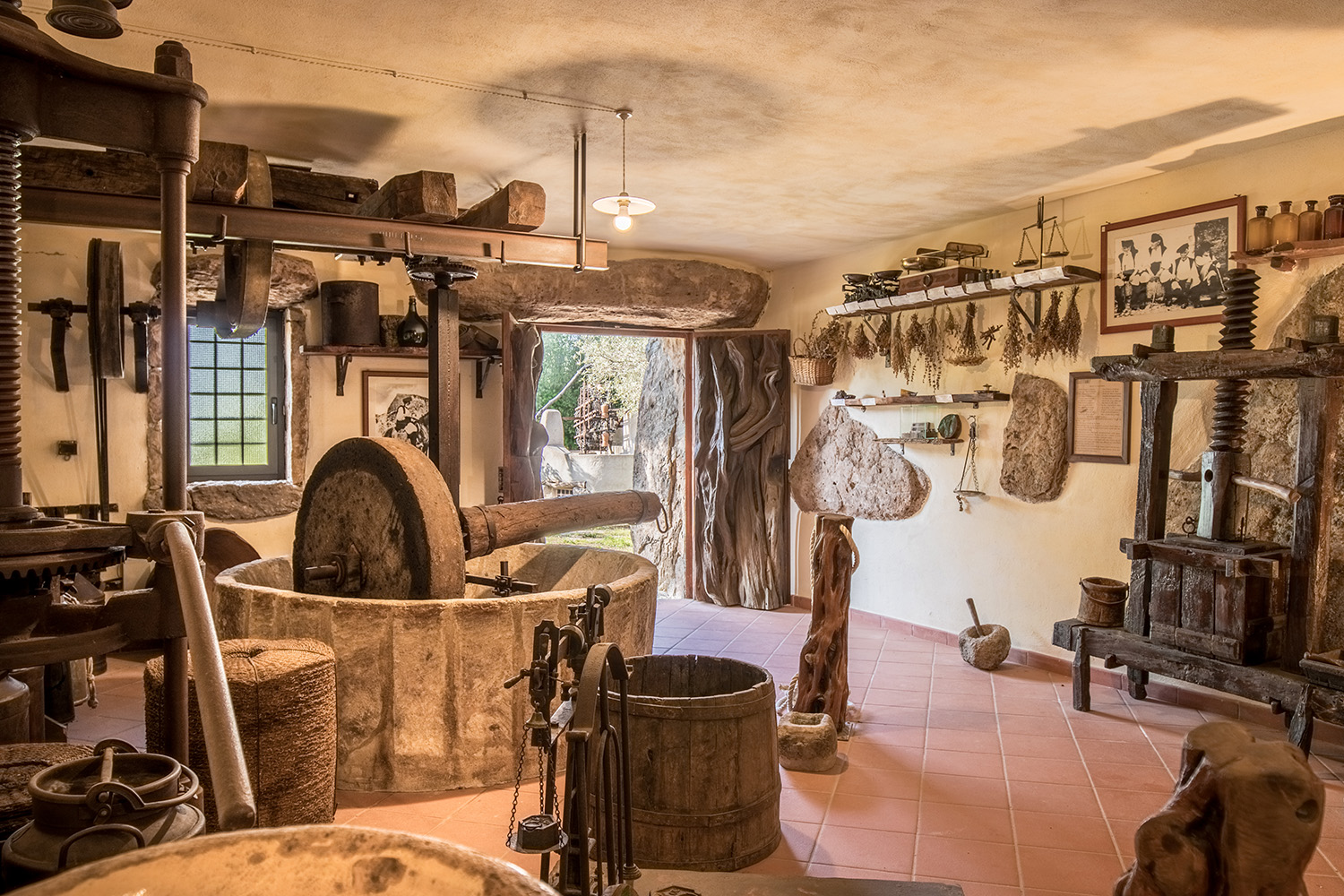
With over 4,500 artifacts on display illustrating life in Sardinia between 1650 and 1940, S’Abba Frisca is the island’s largest ethnographic museum. Over 500 of these artifacts have been catalogued, making S’Abba Frisca the ethnographic museum in Sardinia with the largest digitized repository, accessible through the General Catalogue of Cultural Heritage. The museum, increasingly recognized as a key resource for the study of Sardinian history over the past three centuries, offers both the scientific community and the general public a series of catalogue entries that showcase only a part of its immense collection. The most prized part of the museum’s ethnographic holdings is the collection of edged weapons and firearms, which in 2017 was declared of cultural interest by the Italian Ministry of Culture.
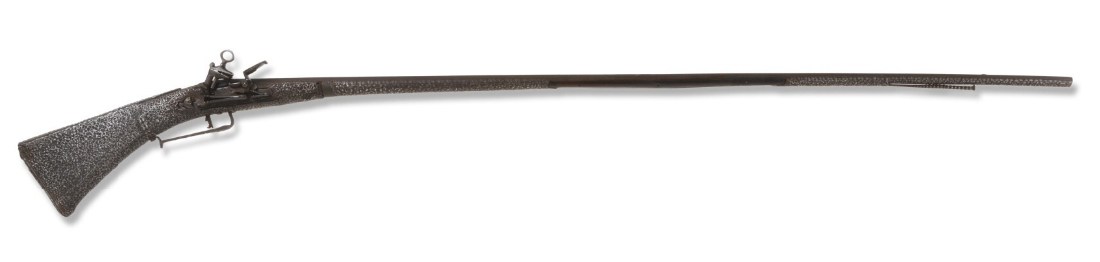
Flintlock arquebus – Cannetta
Antonio Angelo Barbuti signed, toward the end of the 18th century, several firearms now preserved in both public and private collections: from the collection of the Museum of Liverpool to those of prominent Italian antique dealers; as in our case, his mark appears on two arquebuses in the Poldi Pezzoli Museum in Milan, and on a weapon in the collections of the G.A. Sanna National Museum in Sassari. The royal collections also hold several particularly valuable examples (Turin, Royal Armoury). The Barbuti family originated in Lancusi (Salerno) and later settled in Tempio Pausania; this town of the Salerno area had been the site, since 1763, of a firearms factory, the Royal Manufactory of the Piastrinari, managed by a military administrator of the artillery department. Their origin in Campania, a region that in the 18th century developed an independent and renowned arms industry under the Bourbons, with several active manufactories, explains why the “Sardinian” flintlock is essentially a variant of the “Neapolitan” type, differing chiefly in the shape of the lock plate and the hammer. Ignition mechanisms have in fact undergone a continuous series of improvements over time, sometimes merely technical in nature; the stocks changed in shape, configuration and dimensions according to fashion and in response to modifications in the ignition mechanisms. The barrels, often produced in Brescia, were refined as barrel-making techniques advanced, evolving much more slowly than the other components. The first scholar to take an interest in the skilled craftsmen and artists of the Sardinian branch of the Barbuti family was the Milanese archaeologist Carlo Albizzati, who, in a short article published in 1928 in the journal “Mediterranea,” described the fine decorative work on the guns, partly cast and finished with a burin, and partly chased. The Sardinian centres for arms production were Dorgali, Fonni, Gavoi and Tempio itself, where Barbuti resided; he concluded by lamenting that many of these weapons had already been taken away from the island as “travel souvenirs”. For this very reason, the specimens that remain in Sardinia are all the more important.
https://catalogo.beniculturali.it/detail/HistoricOrArtisticProperty/2000246819

Leppa de Chittu – Sabre
Single-edged curved blade, sharpened on the convex side, with a triangular section and concave faces. The spine reaches a considerable thickness where it meets the tang. On the first third of the blade, near the heel, both sides feature an engraving made with a burin depicting a stylized crescent moon. The left side features two stars below the crescent and another two above it. On the right side there are two stars below the crescent and three above it. The wooden hilt, shaped like a feline’s head, is covered with a finely chased brass sheet decorated with geometric patterns, vines, and floral motifs. The right side of the hilt shows greater attention to detail: its three rivets are silver-plated, the one nearest the blade
shaped like a shell, and the other two like flowers. The rivets are connected by a rope-like decorative motif that joins the feline head at the end of the hilt. The eye is also silver-plated. On the underside of the hilt appear the letters MLBD and the date 1871.
https://catalogo.beniculturali.it/detail/HistoricOrArtisticProperty/2000246826
Garriera – Powder Belt
Powder belt known in the Dorgali dialect as a “Garriera”, designed to hold measured charges of gunpowder for muzzle-loading firearms, either percussion or flintlock. It contains twenty-six small tin measures called “attessos”, which could be removed from the belt as needed by unthreading the cord that closed the powder holders at the top. The front part of the belt is finely embroidered in silk thread, with geometric motifs in the central section and floral motifs at the ends. The rectangular brass buckle, engraved with floral designs at the corners and plaited patterns along both sides, was made in the workshop of the Bacchitta brothers, specialists in sabre-handle production. The belt itself was crafted by the leatherworker and ceramist Giovanni Cucca, active in Dorgali between 1890 and 1963. https://catalogo.beniculturali.it/detail/DemoEthnoAnthropologicalHeritage/2000246820
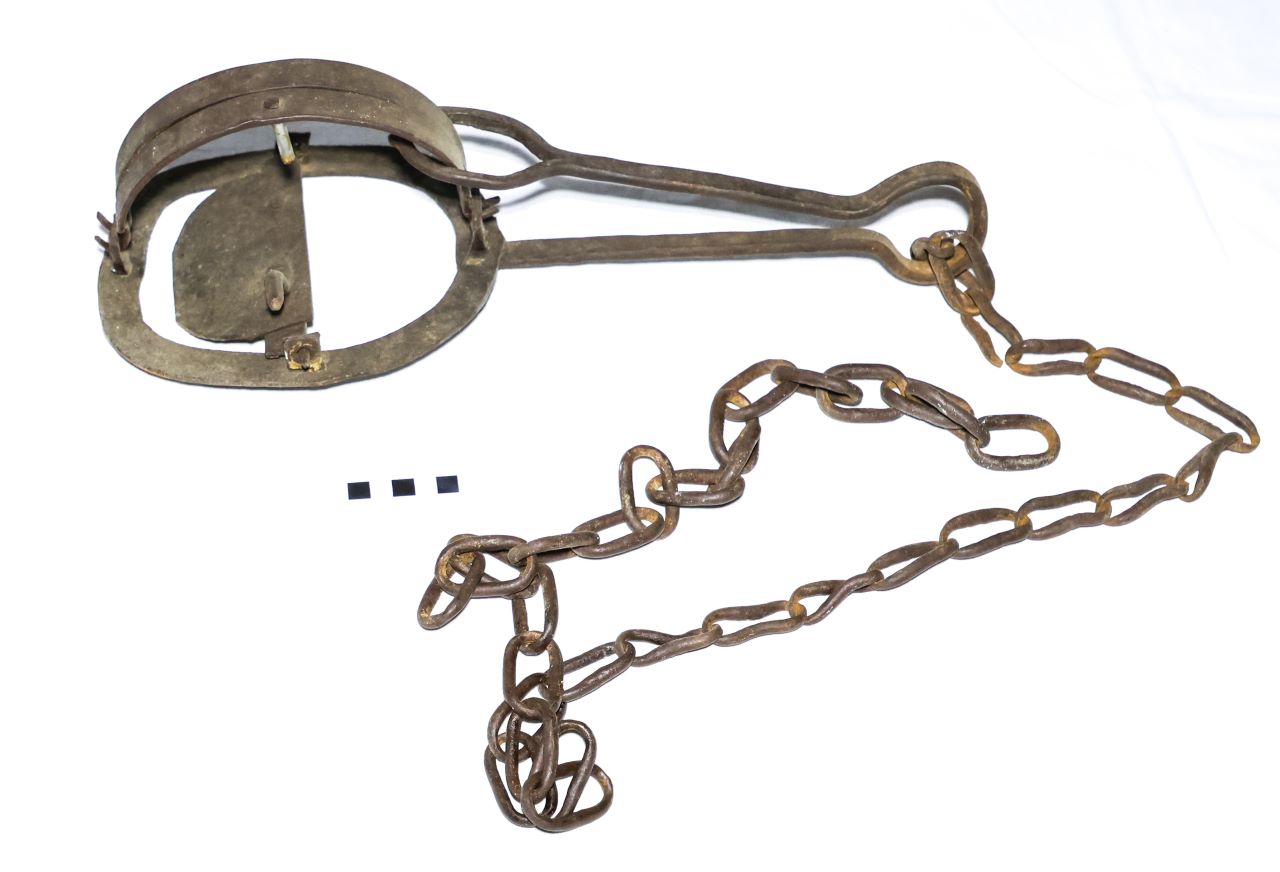
Trappula – Trap
Trap for catching foxes, wild boars, martens, and wild cats.
It was laid on established trails and snapped shut as soon as the animal’s paw ended up inside.
https://catalogo.beniculturali.it/detail/DemoEthnoAnthropologicalHeritage/2000250289
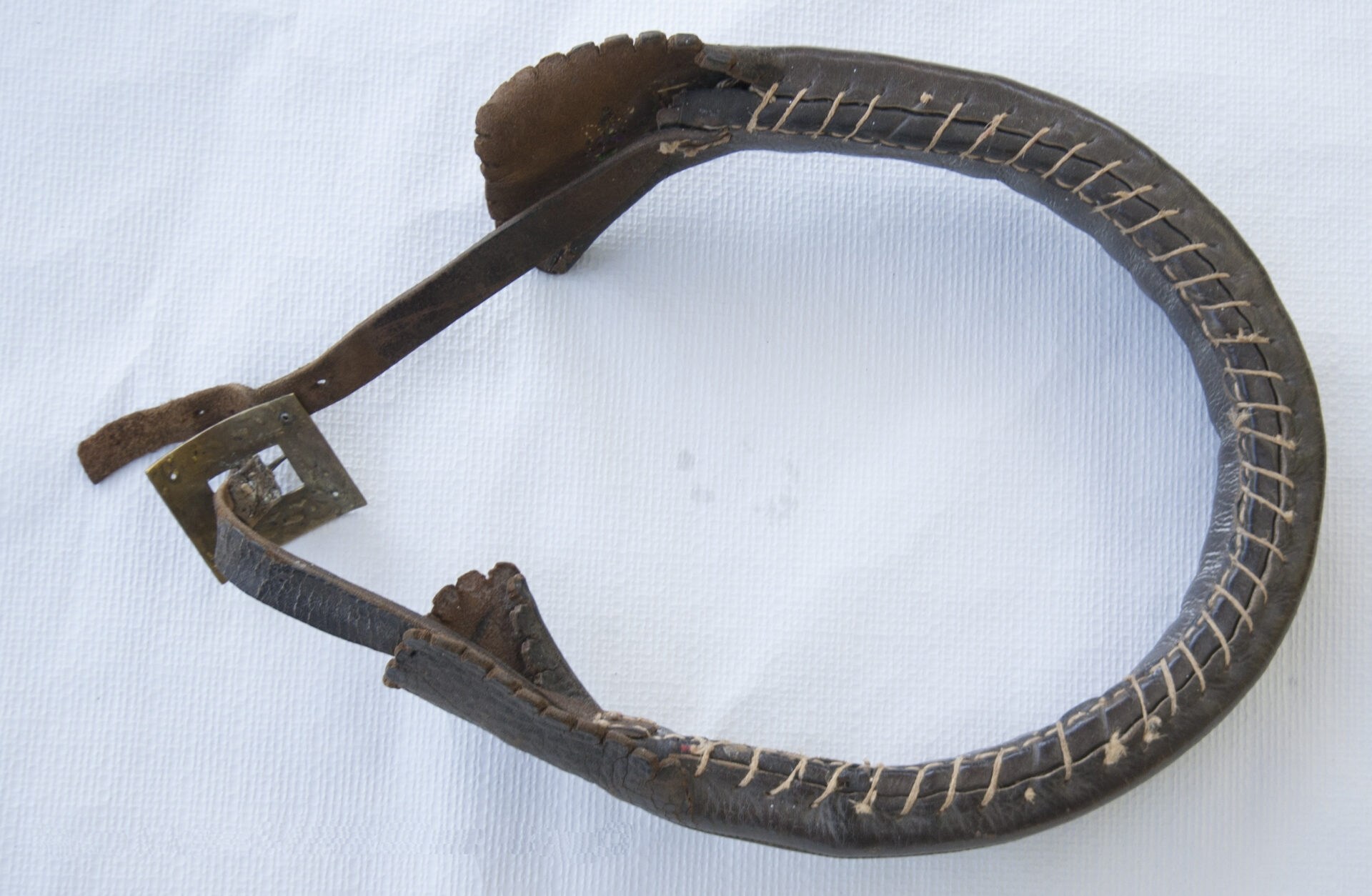
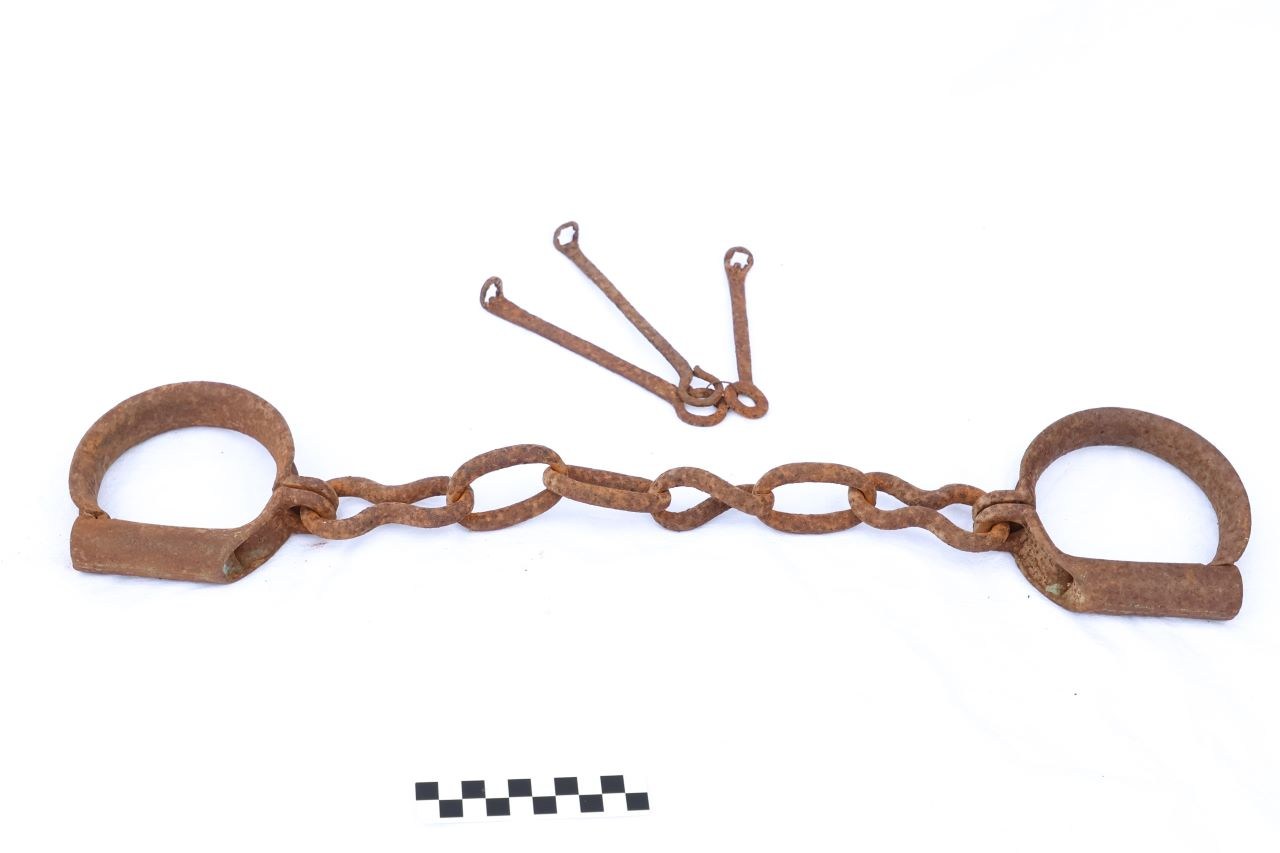
Irfèrias chin cràes – Hobble with Lock
Pastoia per legare le zampe dei bovini al pascolo
Hobble used to tie the legs of cattle while grazing. The device was secured around the animal’s legs to restrict its movements and safeguard against straying or theft.
https://catalogo.beniculturali.it/detail/DemoEthnoAnthropologicalHeritage/2000250337

Carru – Cart
Transport vehicle made of holm oak and poplar wood, with wheels featuring iron treads. The front drawbar section and the load-bearing part are formed by a single-piece shaft (iscàla ‘e carru). The front end, used to attach the oxen, has holes used to secure the yoke with a special pin (crapìca). About one and a half metres from the front end, the shaft gradually
splits into two branches, reaching full separation at the rear. The two sides are held together by planks forming su lettu de su carru (the cart bed) and by sideboards called sas costànas, made of three planks each, designed to hold loads of wood or charcoal. On the sides are four hooks and two iron rings used to secure the cargo. Painted light blue, the cart bears on its right side a small metal plate showing data related to the road tax. The braking system is incomplete.
https://catalogo.beniculturali.it/detail/DemoEthnoAnthropologicalHeritage/2000250362
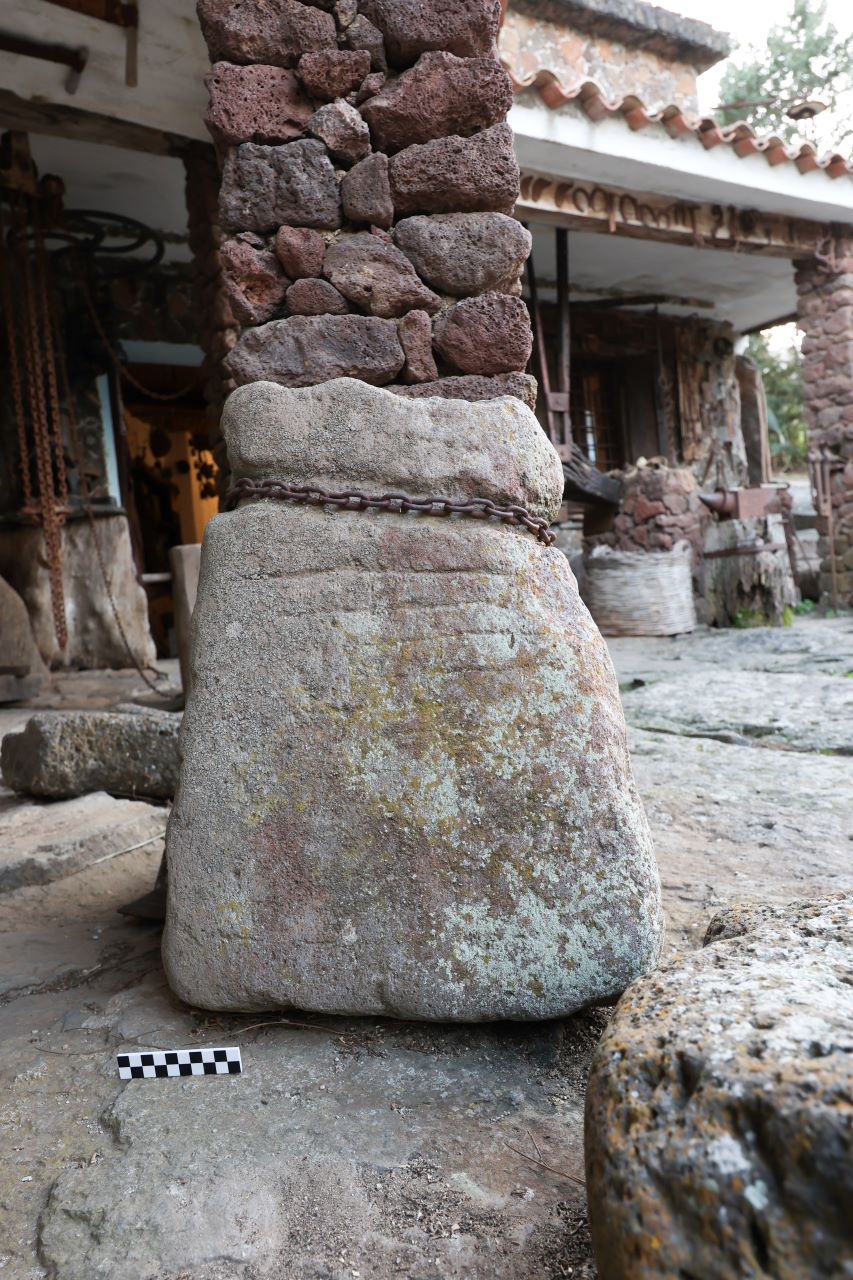
Threshing Stone, prèda de triulare
Trapezoidal trachyte block with grooves and iron chain.
https://catalogo.beniculturali.it/detail/DemoEthnoAnthropologicalHeritage/2000250362
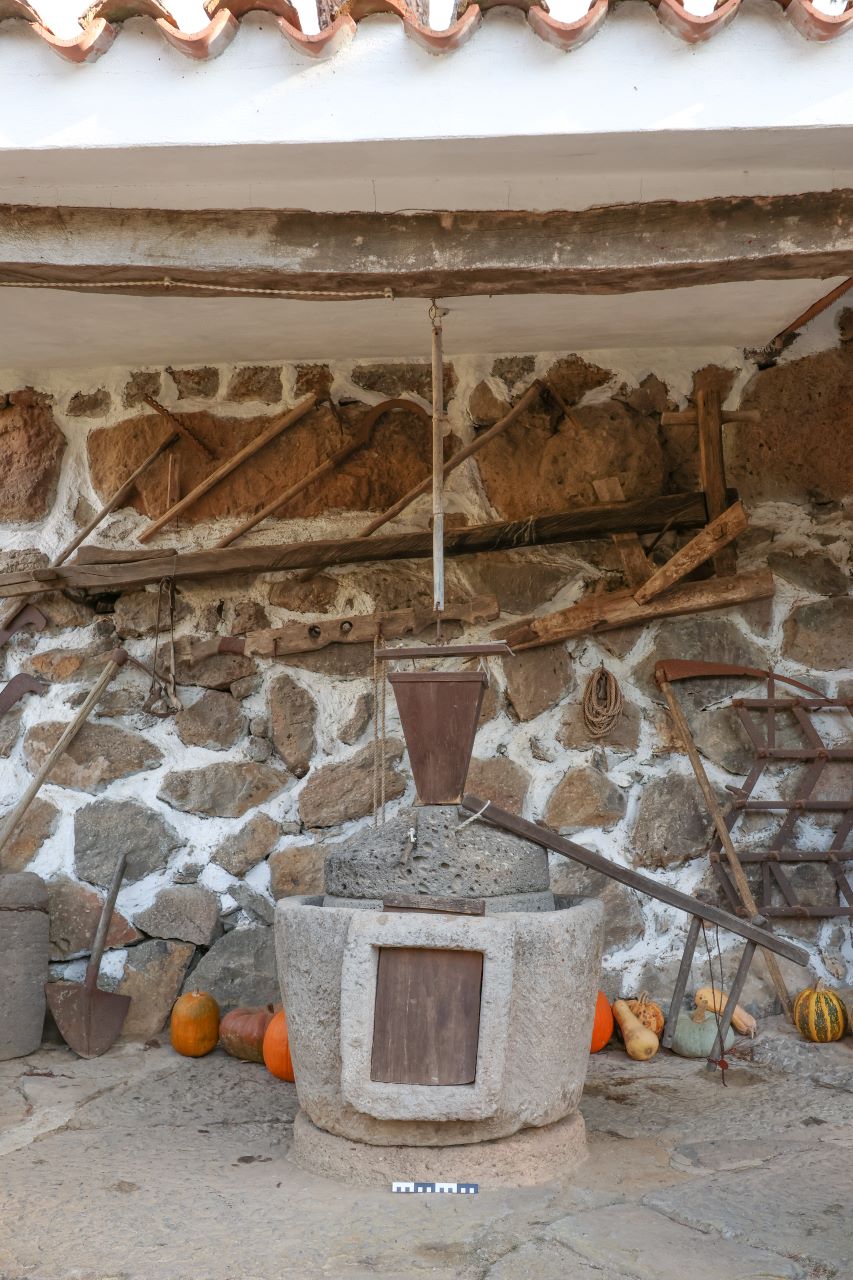
Mola de su tricu – Grain Mill
Donkey-driven mill made of basalt stone, circular in shape. The body of the instrument consists of two parts: the male (“mascru”) and the female (“copercu”). The latter is the rotating section, which has two side slots used to attach it to a large forked juniper-wood pole by means of cords and arbutus-wood pegs; the donkey was harnessed to this pole. The forked pole has two holes through which pass two perforated pins at its base, where a leather strap was inserted to secure the animal’s neck without choking it. The lower part (the male) features grooves made with a hammer to increase roughness and improve grip. The circular trachyte basin supporting the millstone has a square-section opening for the outflow of the ground grain, fitted with a sliding wooden shutter. At the upper end, a wooden funnel known as a “maiolu” is fixed, used to allow the grain to fall into the millstone. It was suspended from the ceiling by means of a cane rod.
https://catalogo.beniculturali.it/detail/DemoEthnoAnthropologicalHeritage/2000250367

Sezione cofinanziata con:
INCENTIVO Decreto Direttoriale n. 385 del 19/10/2022
PROT. PROGETTO TOCC0002372
PNRR – Next Generation EU
COR 15910959
CUP C77J23000830008